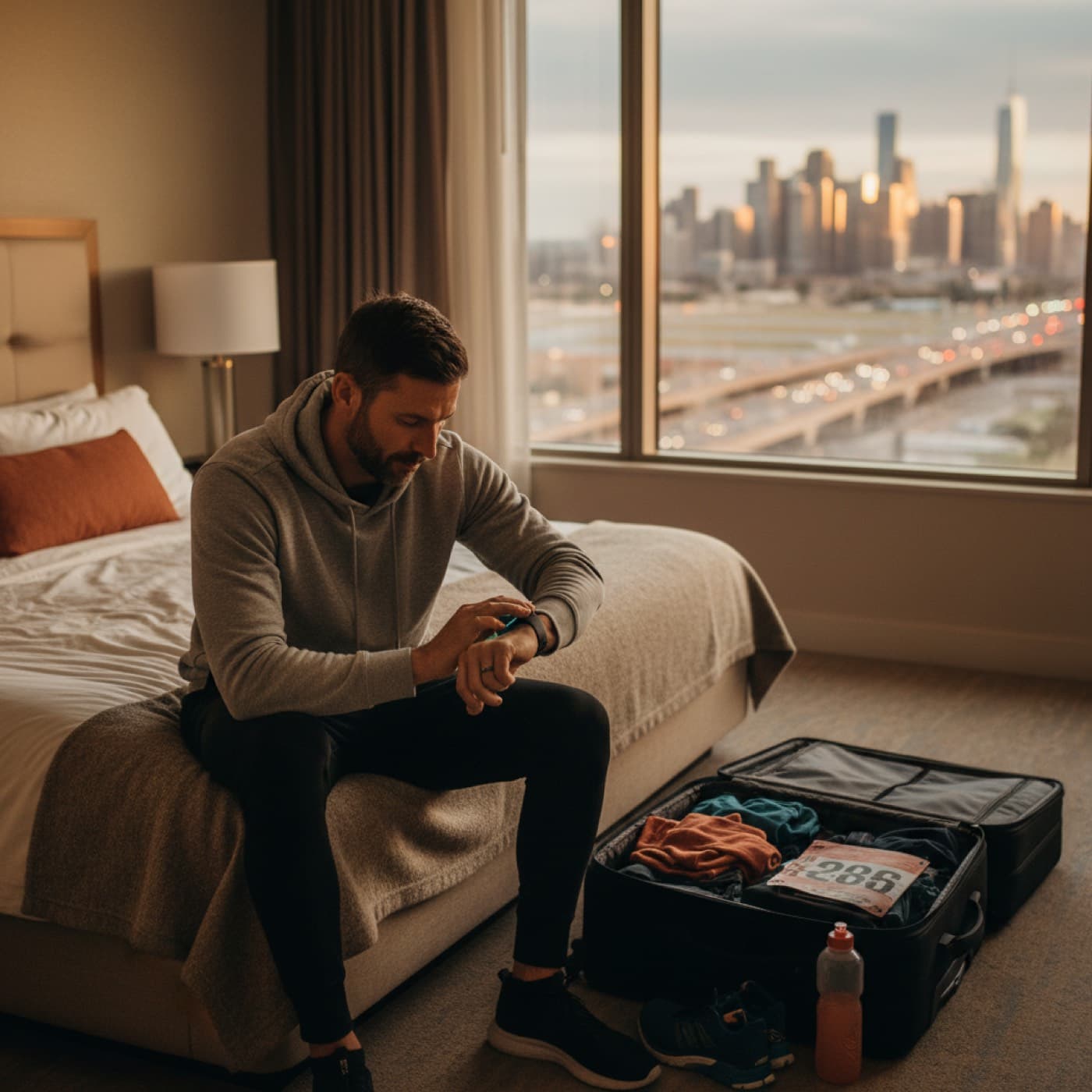
Jet Lag Recovery for Runners: Apple Watch Plan for Race Week
Learn how runners can use Apple Watch sleep, HRV, resting heart rate, and readiness trends to reduce jet lag impact before key sessions or race day.
Written by Leo Cardoso
Jet lag can make fit runners feel under-recovered in 24 hours.
If you travel close to race week, the goal is not perfect adaptation. The goal is making fewer bad decisions while your body clock catches up.
Jet lag is a circadian disruption caused by crossing time zones that affects sleep quality, heart rate variability, resting heart rate, and perceived energy in athletes. A 2021 review in Sports Medicine found that managing travel fatigue requires both behavioral strategies and data-guided daily decisions, since individual recovery timelines vary significantly (PubMed). Apple Watch gives you the signal layer to navigate this in real time.
What jet lag changes in your recovery signals
Continue reading
After long flights and timezone shifts, you may see shorter and fragmented sleep, suppressed HRV versus baseline, higher resting heart rate in the morning, and lower readiness despite reduced training load.
Research on circadian disruption in athletes confirms these effects are measurable and performance-relevant. Studies in team sports show that eastward travel particularly degrades performance outcomes, with the body clock taking 1-2 days per time zone to fully adjust (PubMed).
This is where a structured fallback helps. Start with the sleep debt recovery framework for Apple Watch.
Pre-travel setup (48-72h before flight)
The 48-72 hours before you fly matter more than most runners realize. Small shifts made now reduce how hard your body has to work to catch up at the destination.
- Shift sleep and wake time by 30-60 minutes toward destination time.
- Reduce training intensity slightly.
- Prioritize hydration and sleep consistency.
- Set race-week expectations before you leave.
Goal: start travel with lower fatigue, not with a training deficit.
Jet lag impact: what to expect by direction and distance
Not all travel disrupts the same way. This reference helps you plan realistically.
| Travel type | Zones crossed | Estimated adjustment | Harder direction |
|---|---|---|---|
| Domestic, short-haul | 0-2 | 0-1 day | Eastward |
| Continental | 3-5 | 2-4 days | Eastward |
| Intercontinental | 6-9 | 4-7 days | Eastward |
| Long-haul, east | 10+ | 7-10 days | Eastward consistently harder |
| Long-haul, west | 10+ | 5-8 days | Westward slightly easier |
Eastward travel shortens the perceived day, requiring your circadian system to advance, which is physiologically harder than the delay caused by westward travel. This is why a flight from New York to London disrupts more than the return.
Want to track your own recovery signal after travel? Vita shows your readiness, HRV, and resting heart rate trends from your Apple Watch. Download free.
The first 72 hours after arrival
Day 1: nervous system reset
Keep activity to an easy shakeout only. Get morning daylight exposure as soon as possible after waking. Use caffeine early in the day and cut it off by early afternoon. Aim for an early local bedtime, even if you don't feel tired.
Day 2: tolerance check
Keep your session short and controlled. Compare HRV and resting HR against your normal trend, not against a single reference value. If both are off, keep intensity low regardless of how you feel subjectively.
Day 3: decide race-week intensity
Add quality only if sleep is improving and morning metrics are stabilizing. If not, stay conservative and protect race day. One good morning reading is not enough. Look for two consecutive stable days.
Green, yellow, red model for travel week
Green
Sleep trend is improving, HRV is rebounding, and resting HR is normalizing. Execute your planned quality session.
Yellow
One signal is still lagging, or perceived effort is higher than expected. Keep the structure but reduce intensity and volume by 10-20%.
Red
Sleep is fragmented, HRV is down, and resting HR is elevated. You also feel high perceived fatigue or have heavy legs. Take an easy run or rest day, then reassess.
In-flight habits that reduce recovery time
What you do during the flight affects how quickly you adapt on arrival.
- Set your watch to destination time immediately at boarding.
- Sleep on the plane only if it aligns with destination nighttime.
- Stay hydrated. Cabin humidity is typically below 20%, accelerating dehydration.
- Avoid alcohol during flight. It suppresses sleep quality even when it helps you fall asleep.
- Move every 60-90 minutes to reduce circulatory stagnation.
These habits don't eliminate jet lag, but they shorten the window of disruption.
How sleep timing affects jet lag recovery more than sleep quantity
Most runners focus on sleep duration after travel, but timing matters more.
Your circadian system resets primarily through light exposure and meal timing, not through extra hours in bed. Sleeping 9 hours on the wrong schedule can deepen the misalignment rather than fix it. This is why sleeping until noon at your destination after an eastward flight tends to prolong jet lag, even though it feels like more rest.
Practical guidelines for faster adaptation:
- Expose yourself to natural light within 30 minutes of waking at the destination, regardless of local time.
- Eat meals at destination meal times from day one, even if appetite doesn't match.
- Resist the urge to nap at inappropriate local times. A short 20-minute nap before 3pm local time is fine. Anything longer or later delays adaptation.
- Use your Apple Watch sleep data to confirm whether sleep is shifting to match local patterns. Trend direction matters more than a single night's duration.
This approach won't make jet lag vanish overnight, but it shortens the adaptation window by a day or two in most cases.
Race-week checklist for travel athletes
- Arrive with at least one buffer day when possible.
- Hydrate aggressively in the first 24h.
- Keep meals and bedtime aligned to destination time.
- Avoid adding "compensation" workouts.
- Watch trend lines, not single readings.
- Protect one full low-stress day before race day.
Managing race-week expectations after long-haul travel
If you've traveled more than 6 time zones for a major race, here's a realistic expectation-setting framework.
You will not be fully adapted before race day in most scenarios. That's okay. The goal is to manage the disruption well enough that the cost to performance is minimal.
Research on team sport performance shows that jet lag primarily affects decision-making speed, reaction time, and peak power output, less so aerobic endurance at submaximal paces. For a marathon or long-distance triathlon, the aerobic demand is the dominant factor, and moderate circadian disruption has a smaller relative impact than it does on sprint or high-power events.
This doesn't mean ignoring jet lag. It means calibrating your response:
- If you feel 90% at race start, you'll likely run close to your target pace.
- If you feel 70-75%, adjust your early pacing by 10-15 seconds per mile slower than target, and let the body settle in.
- If you feel below 60%, treat it as a long training run and don't chase time. Safety and completion matter more than the split.
Your Apple Watch readiness score the morning of a race, interpreted alongside how you slept and how your warm-up feels, gives you the most honest pre-race signal available.
Common errors
- Treating jet lag like normal taper fatigue.
- Chasing missed sessions right after travel.
- Using one good morning to justify hard intensity.
- Ignoring sleep debt because mileage is lower.
- Testing race pace when signals are still red.
FAQ
How many days before race should I travel?
More buffer is usually better. When that isn't possible, decision quality matters more than perfect adaptation. A runner who travels 3 days before and manages load well often performs better than one who arrives 5 days early but trains through poor signals.
Can I do intervals the day after a long flight?
Only if sleep and morning signals are clearly stable. Most runners benefit from one easy reset day first. Intervals on a suppressed nervous system rarely produce meaningful training stimulus and raise injury risk.
Why is my resting HR high despite easy training?
Travel stress, dehydration, and circadian disruption can keep resting HR elevated temporarily. It often stays high even when your legs feel fine. Track the trend over 2-3 days rather than reacting to one morning reading.
Should I trust readiness during jet lag?
Yes, if you read it with sleep, HRV, resting HR, and session feel together. A single readiness score during travel gives you a starting point, but the trend and the combination of signals tells the real story.
How is jet lag different from normal race week taper fatigue?
Taper fatigue comes from reduced training and normal nervous system adjustment. Jet lag adds circadian misalignment on top of that, which disrupts sleep architecture, HRV, and hormonal rhythms independently. You can have both at once, and they compound.
Next step
Use Vita to track readiness and trend drift during travel week. Review triathlon race-day readiness on Apple Watch if your event strategy also depends on pacing decisions. And if travel is amplifying existing overtraining patterns, read the burnout signs your Apple Watch can show you.
Track your daily readiness with Vita
Get practical recovery context from your Apple Watch data and stop guessing if you should push or recover.
Download on the App StoreRelated posts

March 14, 2026
Sleeping Heart Rate Apple Watch: What's Normal?
Sleeping heart rate Apple Watch guide: learn what's normal at night, what raises it, and when a change in your overnight trend deserves rest or follow-up.
Read article
March 13, 2026
Body Battery Apple Watch: What to Use Instead
Body Battery Apple Watch isn't a native Apple metric. Learn which Apple Watch signals replace it, how to read them, and how Vita turns them into one score.
Read article
March 08, 2026
Apple Watch vs WHOOP vs Oura: Which One Fits You?
Apple Watch vs WHOOP vs Oura explained for recovery, sleep, HRV, comfort, and long-term cost. Pick the tracker that matches your training style and goals.
Read article